
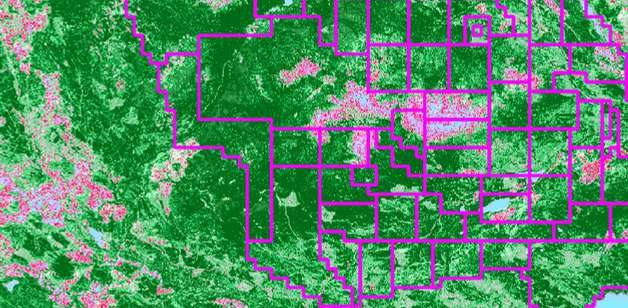
Cumulative effects monitoring
Show how your project adds to the combined pressure on the land, using a baseline you can repeat and update.
For proponents, regulators, and planners in federal, British Columbia, and Alberta processes.
How we help you show your project’s contribution
genesis-ei builds a repeatable baseline across 15 ecological indicators, with an initial analysis in minutes, so you can show how a project adds to existing pressure and keep the evidence current while federal rules settle.
Rules last checked . Most recent changes: On October 9, 2026 the Court of Appeal of Alberta found that the 2024 Impact Assessment Act amendments still did not cure the Act’s constitutional problems. Amendments to the federal project list took effect on September 3, 2026. This is a plain-language summary, not legal advice.
- How does genesis-ei help?
- It builds a repeatable baseline across 15 ecological indicators, with an initial landscape-scale analysis in minutes. A fully verified baseline adds ground truthing by qualified professionals.
- Do the 2026 court decision and project list changes remove the need for this evidence?
- Not by themselves. Federal rules are being reshaped, but British Columbia and Alberta processes also look at cumulative effects, and reviewers and communities still ask for the evidence. Ask counsel what applies to your project.
The question is the same. The rules keep changing.
Almost every approval process now asks how a project adds to everything already on the land. Answering takes a consistent baseline across a whole area, and the evidence is usually scattered across studies from different years.
Federal rules are being reshaped as courts and governments settle how far they reach. A baseline that stays current is useful whichever way the rules land.
- Scattered evidenceStudies use different methods, dates, and boundaries.
- Stale baselinesA study ages the day it ends.
- Moving rulesFederal impact assessment rules are changing in 2026.
- Many readersRegulators, Nations, and communities all need the same picture.
The rules that ask about cumulative effects
Cumulative effects show up in federal, British Columbia, and Alberta processes. This is where each stands as of November 2026.
Federal
- Impact Assessment Act. Requires the federal government to consider the cumulative effects of physical activities, and assessments of designated projects consider cumulative effects likely to result in combination with other activities.
- Rules in flux. On October 9, 2026 the Court of Appeal of Alberta found that the 2024 amendments still did not cure the Act’s constitutional problems. Federal regulations narrowing which projects are covered were issued weeks earlier. The Building Canada Act also changes the process for national interest projects. Ask counsel what applies to your project.
British Columbia
- Cumulative Effects Framework. Gives natural resource decision-makers consistent assessments of values such as aquatic ecosystems, forest biodiversity, and grizzly bear, with guidance for applicants. See our page on the framework.
Alberta
- Alberta Land Stewardship Act plans. Regional and sub-regional plans manage cumulative effects through footprint limits, restoration expectations, and reporting. Upper Smoky came into effect in November 2025, and others are in draft. See our page on caribou sub-regional plans.
Sources: Justice Canada (Impact Assessment Act, current to September 2026), Court of Appeal of Alberta decision summaries by law firms (October 2026), Government of British Columbia (CEF guidance, April 2026), Government of Alberta (sub-regional planning). This is a fast-moving area. Plain-language summary, not legal advice.
One baseline, repeated
ProDelta supports qualified professionals and the existing assessment tools. It does not replace them.
- genesis-ei builds a continuously updated baseline across 15 ecological indicators and growing, with an initial analysis in minutes.
- Repeat analysis shows how conditions change as projects are built and restored.
- rapid-ortho adds high-resolution imagery where detail matters, processed 100 times faster than traditional imagery processing.
- geo-story turns the results into a story every party at the table can read.
What you walk away with
A consistent baseline
One method across the whole area, so results compare cleanly.
A clear view of footprint
Where your project adds to existing disturbance, and where it can be avoided.
A record that updates
Evidence that stays current while the rules settle.
Related land monitoring topics
Cumulative effects draw on every other land monitoring topic.
Questions we hear
What are cumulative effects?
They are the combined effects of a project together with other activities, past, present, and future, on the same land and values.
Do the 2026 court decision and project list changes remove the need for this evidence?
Not by themselves. Federal rules are being reshaped, but British Columbia and Alberta processes also look at cumulative effects, and reviewers and communities still ask for the evidence. Ask counsel what applies to your project.
How does genesis-ei help?
It builds a repeatable baseline across 15 ecological indicators, with an initial landscape-scale analysis in minutes. A fully verified baseline adds ground truthing by qualified professionals.
Does it replace provincial assessments?
No. In British Columbia, the Cumulative Effects Framework assessments are the starting point. genesis-ei adds project-scale detail.
Which rules apply?
Federally, the Impact Assessment Act, whose reach is being decided. In British Columbia, the Cumulative Effects Framework. In Alberta, Alberta Land Stewardship Act regional and sub-regional plans.
Build a baseline that outlasts the rule changes.
Tell us about your project area. We’ll show what a repeatable baseline looks like.